Privacy Policy vs Terms and Conditions: What’s the Difference and Do You Need Both?
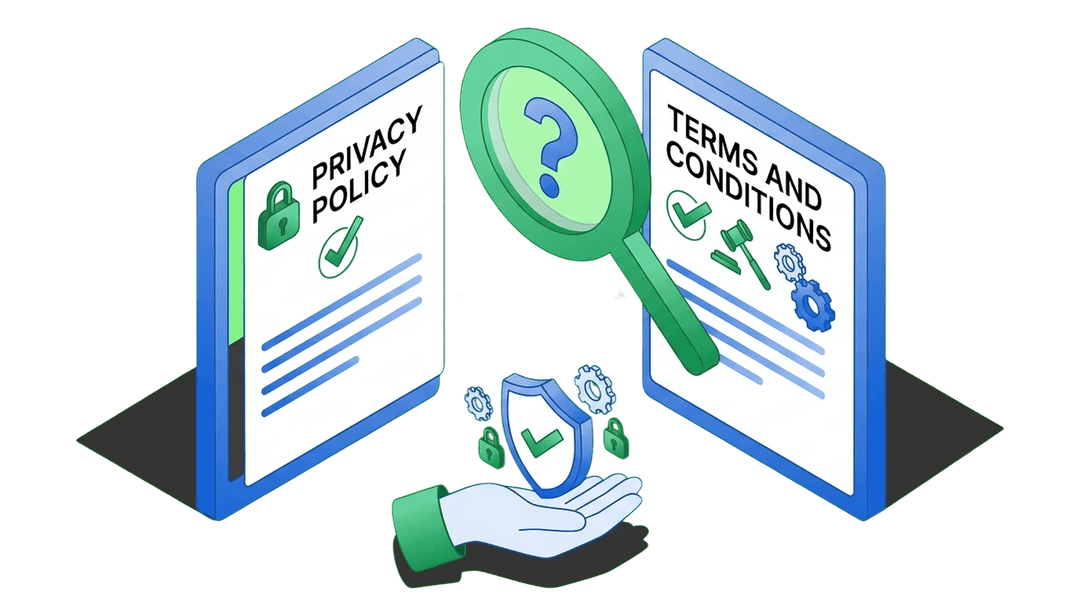
If your website collects data or offers any service, failing to publish a proper Privacy Policy or Terms and Conditions can expose your business to legal action, regulatory fines, and disputes you can’t defend.
Regulators like GDPR and CCPA don’t just recommend transparency—they enforce it. Missing or inaccurate disclosures about data usage can result in penalties, while the absence of clear terms leaves your business unprotected in disputes.
This guide breaks down exactly what each document does, why both are critical, and how to implement them correctly.
What each document does
Privacy Policy
A Privacy Policy explains:
- What personal data you collect
- Why you collect it
- Who you share it with
- What rights users have over their data
It is required under laws like GDPR and CCPA and is designed to protect user data rights.
Terms and conditions
Terms and conditions define:
- Rules for using your website or service
- User responsibilities and restrictions
- Your liability limitations
- How disputes are handled
They are not legally required but are essential for protecting your business.

Related reads:
The simplest way to remember the difference: your Privacy Policy faces outward (it's for your users). Your Terms and Conditions face inward (they're for your business).
| Privacy Policy | Terms and Conditions | |
|---|---|---|
Purpose | Explains how you collect and use personal data | Sets rules for how users may use your website or service |
Protects | Your users' data rights | Your business from misuse, disputes, and liability |
Required by | GDPR, CCPA, and other privacy laws | Not legally mandated, but strongly recommended |
Covers | Data collection, third parties, user rights, retention | Acceptable use, payment terms, disclaimers, IP ownership |
Audience | Any site that collects personal data | Any site offering a service, product, or platform |
What a Privacy Policy covers
A Privacy Policy is a legal document that discloses how your website handles personal data. Under GDPR, CCPA, and most other modern privacy laws, any website that collects personal data must publish one. This includes virtually every website with a contact form, newsletter sign-up, analytics tool, or payment system.
A compliant Privacy Policy addresses:
- What data you collect: names, email addresses, IP addresses, device identifiers, payment details, cookies and tracking data
- Why you collect it: to process orders, send marketing emails, run analytics, improve site performance
- Who receives it: third-party tools and services you use, such as Google Analytics, payment processors, email platforms, named explicitly
- User rights: the right to access, correct, or delete their data (GDPR); the right to opt out of the sale of personal information (CCPA)
- Lawful basis (GDPR): the legal ground for each type of processing, such as consent, legitimate interest, or contractual necessity
- Data retention: how long you keep different types of data
- Contact details: who to contact with data-related requests
A Privacy Policy is legally required in most jurisdictions if your website collects any personal data. This includes analytics cookies, which collect IP addresses and device identifiers. If you have Google Analytics, Meta Pixel, or any email sign-up on your site, you need a Privacy Policy.
What Terms and Conditions cover
Terms and Conditions are not legally required in most jurisdictions, but they are strongly recommended for any website that offers a service, sells products, or has users interacting with content or accounts. Without them, you have no contractual basis to enforce acceptable use, limit your liability, or handle disputes.
A well-drafted Terms and Conditions document typically covers:
- Acceptable use: what users may and may not do on your website or platform
- Intellectual property: who owns the content on your site and what users can do with it
- Disclaimers and limitation of liability: what your business is and is not responsible for
- Payment and refund terms: for any website that takes payment for goods or services
- Account rules: if users create accounts, including registration, suspension, and termination
- Governing law: which country's laws apply in a dispute
- Changes to the terms: how and when you can update the document and how you will notify users
The more your website does, especially if it involves payments, user accounts, or user-generated content, the more important a solid set of Terms and Conditions becomes.
Key differences between Privacy Policy and Terms and Conditions
One is legally required; the other is best practice
A Privacy Policy is mandated by law in most countries where you have users. GDPR (EU/UK), CCPA (California), PIPEDA (Canada), and many others require it. Terms and Conditions are not generally required by law, but they provide the contractual framework that makes your website legally enforceable.
In practice, you can operate a website without Terms and Conditions, but doing so leaves you exposed. You cannot enforce rules you have not published.
They protect different parties
Your Privacy Policy is written for your users. It gives them the information they are legally entitled to about how their data is handled. Failing to publish one, or publishing one that does not accurately describe your data practices, violates their rights under GDPR and equivalent laws.
Your Terms and Conditions are written for your business. They establish the legal relationship between you and your users, set expectations, and limit what users can hold you liable for. A well-written set of Terms and Conditions can be the difference between a dispute that resolves quickly and one that escalates.
They cover entirely different subject matter
There is no overlap in what the two documents address. Your Privacy Policy covers data. Your Terms and Conditions cover everything else, including use, content, payment, liability, accounts, and disputes. They are complementary, not interchangeable.
Combining them into a single document is possible but generally not advisable. Regulators and users expect to find a standalone Privacy Policy, and combining the two can make it harder to satisfy disclosure requirements.
Do you need both Privacy Policy and Terms and Conditions?
For most websites, yes.
If you collect any personal data (contact forms, analytics, email sign-ups, payments), you need a Privacy Policy. This is a legal requirement under GDPR, CCPA, and most modern privacy laws.
If you offer any service, sell any product, or have users interacting with your site, you need Terms and Conditions. This is about protecting your business, not just compliance.
If you are purely informational with no forms, no analytics, and no interaction, you may not legally need either. In practice, this describes almost no website.
The only type of site that genuinely needs neither is a fully static page with no external scripts, no forms, and no data collection of any kind. If you are reading this, your site almost certainly does not qualify.
How to create both documents
Writing either document from scratch takes considerable time and carries real risk of missing jurisdiction-specific requirements. A generator handles the legal structure for you based on your specific website setup.
Terms and Conditions
The Terms and Conditions Generator by CookieYes creates a customised terms document based on your website type, the nature of your service, and any specific provisions you need, including payment terms, user accounts, intellectual property clauses, and more.
Privacy Policy
For your Privacy Policy, the Privacy Policy Generator by CookieYes builds a policy based on your actual data practices, including the tools you use, the data you collect, and the laws that apply to your visitors. It covers GDPR, CCPA, and more.

Shreya
Shreya is the Senior Content Writer at CookieYes, focused on creating engaging, audience-driven blog posts and related content. Off the clock, you’ll find her happily lost in the world of fiction.